Ekowmania & The Rhythmers Berlin's Afro-Highlife Architects Build Bridges Between Continents
Ekow Alabi Savage sits at his drum kit in Berlin, decades of musical DNA flowing through his hands.
The 67-year-old Ghanaian master percussionist has spent nearly half a century crafting rhythms that refuse to be confined by geography or genre.
His latest venture, Ekowmania & The Rhythmers, represents something both ancient and urgently modern – a musical collective that treats tradition as a living, breathing organism rather than a museum piece.
The story begins in Cape Coast, where five-year-old Ekow first touched drumsticks. By fourteen, he’d founded ANABO, later known as Roots Anabo, pioneering what they called “sunlife music” – a fusion that would later take them to Jamaica’s Sunsplash Festival and into the legendary Tuff Gong studios.
But life had other plans. Berlin in the late seventies became his canvas, and he’s been painting sonic portraits there ever since.
What makes Ekowmania & The Rhythmers particularly compelling isn’t just Savage’s impressive resume – though collaborations with Ziggy Marley, Fela Kuti, and Manu Dibango certainly add weight to his musical passport.
It’s the way he’s assembled a band that functions like a cultural embassy. Gbemu Kwame Sometimer anchors the low end with bass lines that seem to communicate directly with ancestral spirits, while Frank Karikari – son of highlife legend Ralph Karikari – carries forward a guitar tradition that predates his birth yet feels absolutely contemporary.
Their approach to highlife music sidesteps nostalgia entirely. Instead of treating Ghana’s signature sound as a relic to be preserved, they treat it as a conversation partner.
Soukous rhythms from Central Africa slide into the mix alongside salsa percussion patterns, creating musical moments that feel both geographically scattered and emotionally unified.
This isn’t fusion for fusion’s sake – it’s the natural result of African musicians living and creating in a globalized context.
The band’s upcoming summer 2025 recordings promise to capture this cultural cross-pollination.
Based on available tracks like “Kwame Nkrumah” and “Good Morning Africa,” expect music that honours Ghana’s first president while addressing contemporary African realities.
“Ananse” references the spider-trickster figure from Akan folklore, suggesting these musicians understand their role as storytellers and cultural bridges.
Savage’s 2024 album “Dr. Afrodub” – a collaboration with Finnish producer Jimi Tenor – offers clues about where Ekowmania & The Rhythmers might be heading.
That project demonstrated his willingness to let African rhythms swim in electronic waters, creating hybrid sounds that feel both ancient and futuristic.
The upcoming Rhythmers material will likely push these boundaries further, especially given the ensemble’s reputation for live performances that turn venues into temporary cultural crossroads.
There’s something profoundly contemporary about musicians who refuse to be limited by single cultural identities. Savage and his Rhythmers colleagues represent a generation of African artists who’ve lived through colonialism, independence, globalization, and digital revolution – and somehow managed to keep their musical cores intact while constantly evolving.
The multilingual approach – songs in Fante, Creole, and English – reflects this cosmopolitan perspective. Language becomes another instrument, another way to build bridges between cultures.
Ekowmania & The Rhythmers: Berlin’s Afro-Highlife Architects Build Bridges Between Continents
When Savage sings in Fante, he’s not just communicating with Ghanaian listeners; he’s introducing non-African audiences to the rhythmic possibilities of his mother tongue.
What strikes me most about Ekowmania & The Rhythmers is their refusal to choose between tradition and innovation. They’ve created a musical space where palm wine guitar techniques can coexist with contemporary production methods, where ancient percussion patterns can support modern lyrical concerns.
This isn’t about preserving culture in amber – it’s about keeping culture alive by allowing it to breathe, grow, and interact with other musical traditions.
The fact that new recordings are planned for summer 2025 suggests these musicians aren’t slowing down.
At an age when many artists might be content to rest on their considerable laurels, Savage continues pushing forward, creating music that honours the past while refusing to be imprisoned by it.
Ekowmania & The Rhythmers offer something increasingly rare in contemporary music: genuine cultural synthesis that feels both natural and necessary.
They’re not just making music; they’re demonstrating how tradition and innovation can dance together, creating something more powerful than either could achieve alone.
Da Big Mike Delivers The Groove On New Single “DOINZ”
Growing up on legendary Afrobeat giants, Da Big Mike is slowly conquering this space with his new single “DOINZ.” The addictive drumming, slick basslines, and captivating melodies in this Afrobeat song make you move. It’s a feeling that turns every moment into a dance floor. “DOINZ” infuses African rhythm and soul while challenging global boundaries. Its authentic and appealing sound combines traditional Afrobeat with modern production. The Nigerian artiste wants you to feel like we’re all in this together, vibing and having fun so you aren’t left alone. The opening beat urges you to sink into the rhythm and mood as it hits your chest and spreads through your body. This infectious Afrobeat tune combines rhythm, energy, and soulful ethnic elements to captivate your body. Additionally, the song features a stunning music video that you should watch. Ride this wave together and follow him on Instagram and TikTok. Stream the song here
Dancing with Ancestors: Inside Mystic Wolf’s Collective Liberation
Mystic Wolf’s new EP, Collective Liberation, is much more than music. It’s a powerful message for change. This bold release focuses on taking back power, revolution, and spiritual healing. It works as both a call to action and a deeply personal gift to listeners. The EP blends electronic folk music, tribal beats, ambient sounds, and mystical folk to help people imagine a world built on working together, sharing, and ancient wisdom.
Working with Agami Records through the SEEDS of Light Campaign, this project supports the Guarani people in southern Brazil as they fight to reclaim their land and freedom. From Montana to Palestine, from New Zealand’s forests to North America’s streets, Collective Liberation brings together Indigenous resistance, environmental care, and the sacred bond between people and Earth.
Mystic Wolf’s music serves as both spiritual teaching and a soundtrack for major change. Through meaningful sounds and purposeful action, they connect the conscious music community with real-world activism. Here, dancing becomes protest and sound becomes solidarity.
We spoke with Mystic Wolf to explore the spiritual and political power behind this visionary release.
Mystic Wolf, congrats on your new release! What inspired the creation of “Collective Liberation”?
The Collective Liberation EP is a call to action for decolonization, revolution, and communal healing to reimagine the ways that humans relate to themselves, to one another, and to the Earth beyond a paradigm of domination, extraction, and exploitation. This EP sets the vibrational stage for building a world based on solidarity, reciprocity, and self-determination.
Honoring the roots of our pre-colonial ancestors, while honoring and tangibly supporting Indigenous People who resist colonization and embody the definition of resilience today, leads us to a future where all peoples and communities thrive. I hope that my music can be the soundtrack for the revolution in our hearts and out in the world. So I wanted to create an EP that specifically focuses on that intention.
The title alone feels deeply political and spiritual—what does collective liberation mean to you? Collective liberation means that all of our liberation and the health of the planet are inherently connected to one another. None of our struggles are separate. None of us is free, until all of us are free.
The overarching system of white supremacist, capitalist, imperialist patriarchy harms every single person on this planet (even the people the system seemingly materially benefits), so dismantling that system and building a new liberatory social and economic system frees everyone. For instance, the plight of white working class Southerners is tied to the liberation of Palestine.
The overarching system of white supremacist, capitalist, imperialist patriarchy harms every single person on this planet
How would you describe the sonic landscape of “Collective Liberation”? What genres or elements are woven into it? I would describe my music as folktronica, organic electronic, and world electronic that fuses cosmic folk with ethereal electronic textures and multicultural rhythms. The music creates a synergistic confluence, where earthy electronic tribal beats weaves with ambient dreamy expansive tonal radiance and mystical organic folk instrumentation.
The energy is astral, yet primal. While I’m from Montana, my ancestral heritage is Scottish, so I include that ancestral connection of Scottish, Celtic, Gaelic elements into my music as well that creates a mystical enchanted feeling that you’re dancing with elves and fairies.
Your name—Mystic Wolf—feels powerful and intentional. How does it connect to the themes of this EP and your broader artistry? The wolf is a spiritual symbol that serves as a guide, pathfinder, and forerunner of new ideas that returns to the clan to teach and share medicine. Wolves have extremely strong social bonds that center the community. They are caregivers, protectors, explorers and leaders who hold great wisdom.
They are also the most persecuted animal and their struggle in the face of colonization is a symbol for and is interwoven with human struggles for liberation. The wolf has been one of my most powerful teachers and guides that I am deeply connected to spiritually, so I seek to channel this medicine through my music. Wolves embody the energy of my highest self that I aspire to through my own healing.
I also am from northwest Montana and have spent my life backpacking and have had many beautiful encounters with wolves. In my eyes, they are the most majestic animal. And I bring a mystical, cosmic, astral, spiritual vibe to my music and persona that reinforces the spiritual power of wolves.
How does spirituality or mysticism inform your approach to songwriting and performing? Making music is channeling the universal divine source of all that is and then it is distilled and shaped by our own unique vibration and energy that each artist produces, expresses and externalizes out to the world. The people who resonate with an artist’s music have an aligned frequency to that artist, which is why music taste is entirely subjective. That connection between the artist and the listener is a deeply profound spiritual connection that operates at the purest form of existence – vibration.
Hence, why music is considered the language of the universe. It’s not just what you physically hear, but what you feel. Making music is inherently mystical and spiritual, even if some artists don’t frame it as such. My sound happens to have that cosmic, mystical, astral vibe because that’s how the divine source expresses itself through me.
I want my music to be healing and make the listener feel like their soul is being massaged, while giving a sense they are returning to a more natural form of existence, like they are barefoot in the forests, jungles or deserts surrounded by animals and community that connects them to their ancestors.
Do you see your music as a form of activism or healing? How does “Collective Liberation” contribute to those goals? I use my music as a vehicle for collective liberation movement building, while producing sonic landscapes, vibrations and frequencies that supports the listener on their own inner healing and transformational journey. Because healing is the process of aligning our own vibration to our highest selves and externalizing that light to heal the world. And music is the universe’s vibrational tuner to do that.
I seek to serve as a bridge between the conscious music and spiritual communities and collective liberation movement building. We are spiritual beings having a physical experience and the language of the physical world is action. We have a responsibility as spiritual beings in the conscious music scene to center a collective liberation framework in our practice. It is the highest vibration to confront genocide and capitalist dehumanization. Unity is achieved through action that exemplifies solidarity.
Collective Liberation is a project that materially supports Indigenous self-determination. The Guarani people have been reclaiming their land in southern Brazil in the face of violence from the agribusiness and ranching industries. I released my EP through Agami Records and they have been a partner of these Guarani communities to support these land reclamation efforts, as part of the Agami SEEDS of Light Campaigns.
This EP is a part of Agami Records SEED 4: Humans and Spirituality Campaign that shines a light on cultural biodiversity and explores cultures that promote health, sustainability, and regeneration on all levels. All proceeds from the EP go directly to these Guarani communities.
Where do you see Mystic Wolf heading next—musically and thematically? I honestly just started making music a year and a half ago, so I have A LOT more to learn about making music and have an infinite amount of growth left on my path. So I’m here to learn and grow, and see where the universal flow takes me, while honoring my mission of using music as a platform for collective liberation movement building and spiritual and emotional healing, that also gets people dancing and having a great time. All else is minutiae that the universe will help guide me towards.
Pastels and Pulse: “Hypnotized” Blends Art with EDM Energy
“DJ Thommek’s latest single “Hypnotized” is a shot of pure dancefloor electricity—tight, uplifting, and impossible to sit still through. Clocking in at just under three minutes, the German EDM producer packs emotion, energy, and artistry into every second. What began as a raw piano riff has been transformed into a full-bodied house anthem, crafted with precision in Ableton after years of sonic exploration.
The track opens with shimmering clarity, then dives headfirst into a rhythmic rush of synth layers and driving beats. It’s a familiar structure—but DJ Thommek’s execution is fresh and vibrant, pulling classic dance elements into the present with slick production and undeniable groove. The vocals are a standout—confident, euphoric, and full of life—cutting through the track with just the right touch of rawness.
But what truly sets “Hypnotized” apart is the personal touch. Not only did DJ Thommek build this track from the ground up, he also hand-painted the cover art using pastel chalk. It’s a small but powerful detail that reflects his holistic, heartfelt approach to music-making.
With “Hypnotized,” DJ Thommek proves that electronic music doesn’t have to sacrifice soul for energy—it can have both, and it can make you move while meaning something more.
Jack Horton's 'Imperfections': When Broken Becomes Beautiful
Jack Horton arrives at a curious cultural moment. In 2025, as social media algorithms push us toward perfection and polish, here comes a Portland-based songwriter-pianist with an EP literally titled Imperfections. The audacity feels refreshing, almost rebellious.
Horton, formerly known as Cullen Jack, channels influences ranging from Jim Croce and David Foster to Ed Sheeran and Morgan Wallen, but his artistic DNA runs deeper than stylistic borrowing.
This is someone who spent years in Tokyo piano bars, working through Japanese law school one weekend gig at a time, before eventually abandoning legal practice for the precarious art of songwriting. That biographical arc informs every note of Imperfections.
The EP’s opening track, “Set Me Free,” emerges from what might be considered failure – Horton’s divorce. Yet his treatment of this subject matter reveals sophisticated emotional intelligence.
Rather than wallowing in self-pity or assigning blame, he locates grace within dissolution. The piano arrangement breathes with quiet confidence, supporting vocals that suggest hard-won wisdom rather than bitter reflection.
His approach to “String Around My Finger” demonstrates remarkable narrative economy. The song chronicles a songwriter choosing love over Nashville ambition, but Horton avoids cliché through specific detail.
His music bridges cultures, drawing from experiences performing in both Tokyo and the U.S., and this cross-cultural perspective adds unexpected depth to what could have been standard Americana fare.
The decision to cover Jim Croce’s “Operator” initially seems puzzling. Why would an artist building his own identity reach for such familiar material? But Horton’s reimagining justifies the choice.
Where Croce’s original carried desperate urgency, Horton finds contemplative melancholy. It’s interpretation as archaeology – excavating buried emotional layers from a beloved classic.
“Never Know Why,” featuring Vesper Stockwell, shifts the EP’s emotional centre. The duet format allows Horton to explore relationship dynamics from multiple perspectives, creating conversational intimacy that feels genuinely vulnerable rather than performatively raw. Stockwell’s contributions suggest artistic partnership rather than mere collaboration.
The closing track, “Space and Time,” revisits material from Horton’s 2023 catalogue but benefits from contextual reframing. Surrounded by songs about transformation and acceptance, this reworked version gains new resonance.
It functions as both conclusion and prelude – acknowledging past wounds while suggesting future possibilities.
What distinguishes Imperfections from countless other singer-songwriter releases is Horton’s refusal to present himself as victim or hero. These songs inhabit the complex middle ground where most actual human experience occurs.
His piano playing – informed by classical training but softened by years of bar performance – provides sturdy foundation for narratives that resist easy categorization.
The EP’s production choices reveal careful consideration of sonic space. Nothing feels overproduced, yet every element serves clear purpose. Horton understands that intimacy requires precision, not just proximity.
Folk and Americana currently experience renaissance among younger listeners seeking authenticity in an increasingly artificial cultural moment. Artists like Fleet Foxes, Caamp, and Bon Iver have demonstrated how folk music can evolve while maintaining its core essence. Horton joins this conversation from his own unique angle – that of the late-bloomer who found his voice after trying on other identities.
His bilingual background and Tokyo experience suggest fascinating future directions. While Imperfections operates primarily within American folk traditions, hints of broader cultural awareness surface throughout. This cosmopolitan sensibility distinguishes Horton from more provincial contemporaries.
The EP’s greatest strength lies in its emotional honesty without emotional exhibitionism. Horton shares personal material but maintains appropriate boundaries. He invites listeners into his experiences without demanding specific responses. This approach creates space for individual interpretation while maintaining artistic integrity.
Jack Horton’s ‘Imperfections’: When Broken Becomes Beautiful
Contemporary songwriting often suffers from either excessive confession or studied detachment. Horton navigates between these extremes, finding territory that feels both personal and universal.
His divorce becomes metaphor for any necessary ending; his love story suggests broader truths about choice and commitment.
Imperfections functions as both artistic statement and emotional document. Horton has created something simultaneously specific to his experience and broadly applicable to human condition. The EP’s five tracks offer sufficient variety to sustain repeated listening while maintaining clear artistic vision.
Perhaps most remarkably, Horton makes vulnerability sound like strength rather than weakness. In our current cultural moment, when authenticity often gets weaponized for social media consumption, his genuine approach feels almost radical.
This EP suggests an artist just beginning to access his full potential, someone whose life experience finally aligns with artistic ambition.
Imperfections may be Horton’s statement about embracing flaws, but the music itself reveals an artist approaching his own form of completion.
Sound Liberation’s “Elegy” isn’t so much an album as it is an unbolting of several sonic cages, letting the inhabitants mingle, argue, and eventually, find a strange, compelling harmony. Gene Pritsker and his rotating ensemble are, as ever, on a crusade against the “segregation of sound vibration,” and here, their weapon of choice is grief, remembrance, and an absolutely defiant refusal to sit still stylistically.
The title track, “Elegy,” sets a certain somber table, yes, but then tracks like “Dealin’ With It” – a tribute, I hear, to Pritsker’s lost friends Sean Satin and David Gotay – knock over the cutlery with a blast of raw, living energy. It’s an interesting way to mourn, less about quiet contemplation and more about a vibrant, noisy wake. One minute, a hip-hop beat is driving the narrative, the next, a classical flourish appears, unannounced, like a surprisingly well-dressed ghost at a party.
Then there’s the opera, the funk, the jazz – it’s like channel surfing through a very eloquent, very heartbroken consciousness. For a fleeting moment, a particular blend of spoken word over a neo-soul groove reminded me of the specific, slightly damp scent of a second-hand bookstore I once visited in a downpour in Prague, filled with books in languages I couldn’t read but whose stories I felt I understood.
Listen Deep: Sound Liberation’s Complex “Elegy”
This album doesn’t just blend genres; it throws them into a particle accelerator. Sometimes you get pure gold, sometimes a fascinating new element, and sometimes, well, a delightful little explosion that leaves you wondering what just happened. It’s reflective, certainly, but it’s a reflection seen in a shattered mirror, each piece showing a different angle of the same, aching core.
Does “Elegy” soothe? Not always. Does it comfort? Perhaps in the way that knowing you’re not the only one feeling complex things can comfort. Mostly, it makes you listen. Really listen. And what, in these fleeting moments, is more vital than that?
Maverick Smith Ignites A Raw Rebellion with "We Make Fire, They Make Smoke"
Maverick Smith’s “We Make Fire, They Make Smoke” lands not with a thud, but with the distinct, satisfying crackle of something catching alight. It’s a title that carries the grit of the Ohio Valley in its consonants, a resolute statement from a band – Paige Bosic on commanding vocals and rhythm guitar, Sean Boynes sculpting soundscapes on guitar, Jim Courtney’s intricate drumming, Charlie Kovach’s incisive lead lines, and Chuck Ellis’s anchoring bass – clearly weary of the ephemeral. They seem to be asking, quite simply, what’s real anymore?
The nine tracks within are a fascinating ramble, less a straight highway and more like following an absorbing, slightly unpredictable river through ever-changing terrain. Alt-rock is the primary current, yes, but Maverick Smith steers into eddies of punk urgency, the dusty sincerity of alt-country, even moments where orchestral strings bloom unexpectedly, like discovering a pressed, forgotten wildflower in a dense volume on quantum mechanics.
It’s a testament, perhaps to Boynes’s hand in production and the band’s collective instinct, that this genre-fluidity never feels like a jumble; every sonic turn serves the song’s emotional core. No samples, no digital trickery taking precedence – just the honest hum and thrum of real people playing real instruments, which, frankly, feels like a quiet act of rebellion in our current age.
Maverick Smith Ignites A Raw Rebellion with “We Make Fire, They Make Smoke”
Lyrically, this album is less a tidy story and more like sifting through a drawer of deeply personal, unlabeled mementos – a sudden jolt of reckless joy here, a half-faded snapshot of regret there. There’s a potent strain of that particular nostalgia, the kind that ambushes you – like unexpectedly catching the scent of your childhood home on a stranger passing by – a sharp, beautiful ache for something irretrievably past.
This bittersweet recognition of time’s relentless flow chafes against a clear-eyed disillusionment with the flimsy structures of modern connection, what the band’s themes describe as a “curated unreality.”
Maverick Smith Ignites A Raw Rebellion with “We Make Fire, They Make Smoke”
“We Make Fire, They Make Smoke” doesn’t attempt to soothe your anxieties with platitudes; it’s more inclined to throw another log on your internal fire, then sit with you companionably by the blaze it creates.
It’s complex, a little frayed at the edges like a beloved old coat, and pulses with a stubborn, resilient spirit. Does it, in its raw honesty, remind us that even when surrounded by the billowing, insubstantial stuff, a single, authentically struck match can still illuminate a profoundly dark room? I rather think it does.
Majority of songs are made with heart- but this one is made with hospital. Please welcome Dr. Alejandro Estrada a working doctor who has done something very special in his music project ESTRADA. He is uniting two worlds that are totally opposite to each other: medicine and dark synth-pop music. His newest single You Are Not Alone is not just a song but a real message of hope to patients who are going through hard times but more so those who suffer in silence.
The song itself began with a true episode of Dr. Estrada and one of his patients. He has applied that experience to create a strong blend of alternative rock and synth that just knocks you out. The meaning is straightforward yet meaningful: nobody should need to go through tough times alone.
But now here is where it really gets interesting. The music video is made with the help of artwork, which is painted with the help of living bacteria and fungi, which were grown in lab dishes with the help of blood, urine, and other body fluids. It seems strange, but this is the beautiful way to demonstrate that even in the most medical, clinical contexts, there is a place where something significant and artistic can be found.
Dr. Estrada is preparing his debut full album titled W/L (the UK medical term, the waiting list). We had a chat with him on how he makes his music, his inspirations, and how he is making use of the sounds of daily life in the hospital and transforming it into something that is not only explosive but also endowed with optimism.
Congratulations on your new single! What inspired you to write “You Are Not Alone”? Those patients with a serious illness who hid it from their families to avoid suffering. Whatever the reason for this decision, I just want to remind them that they are not alone in this difficult process.
Was there a specific moment or experience that sparked the creation of this song? I saw a specific patient in the clinic with a specific condition in this situation.
The title itself carries a powerful message—what does “You Are Not Alone” mean to you personally? No one will give you more support than your loved ones, but whatever the reason why this isn’t possible, you should always have the support of your medical team, and we (as a medical team) must also understand each patient’s personal situation.
Can you walk us through your creative process for this track—from the first idea to the final mix?
It all started with the sound of a ventilator and a letter dictated to a patient with the results of a test. My bass provided the melody, and the analog synths did the rest.
How would you describe the sound or genre of “You Are Not Alone”? Did you try anything new sonically this time? This song is from my first album, which clearly reflects my synth-pop influence. I tried to keep all the songs in the same style, but on this one in particular, I combined acoustic drums and drum machines.
The song seems to touch on emotional resilience and connection. What message were you hoping listeners would take away? They are never alone on this difficult path of illness/medical conditions.
Is “You Are Not Alone” connected to any broader themes or stories you’re exploring in upcoming releases? Yes, my first album is called “W/L,” which is the medical term we use for “waiting list,” and it’s about the long wait times patients have to wait to be seen or treated in our medical institutions in the UK.
Will there be a music video or visualizer for the single? If so, what can we expect? I’ve created artistic figures using cultures of human fluids, including urine, blood, and even semen. I know it’s crazy, but what else can you expect from me if I’m a urologist? 🙂
What’s next for the ESTRADA Music Project? Any new music or collaborations on the horizon? A full album to be released very soon
What artists or albums have been inspiring you lately? The Smiths, Suede and Depeche Mode as my strong influences, but other most crazy things such as The Ninth Wave or Sleaford Mods
What do you listen to when you need to remind yourself that you are not alone? Morrissey, Bret Anderson and Alain Whyte I guess
Introspection in Motion: Farbod Biglari's "Waltz for Baran"
Farbod Biglari’s new single, “Waltz for Baran (The Rain Waltz),” arrived like a polite invitation to a forgotten ballroom, where the chandeliers are lit but the guests are all pleasingly melancholic figments of memory. It doesn’t swagger; it glides, a full orchestral sway that clearly tips its hat to the spirit of composers like Stelvio Cipriani, not by mimicry, but by sharing a certain sophisticated, almost velvety ache. This isn’t background music; it’s foreground feeling.
There’s a deep well of personal story here, a sense that Biglari is dancing with ghosts – pleasant ones, mostly, tinged with a delicate wistfulness. The theme of revisiting past creative sparks with fresh eyes resonates. It’s less about simple recall and more like finding a dried flower pressed in a book you haven’t opened since adolescence, the colour faded but the form, and the feeling it once held, surprisingly, persistently intact.
You know, sometimes the sound of a particular cello voicing, rich and mournful like the ones that sigh through this waltz, reminds me, quite unexpectedly, of the specific quiet that falls over a grand, empty museum gallery just before closing, a silence filled with the weight of unseen stories rather than their absence.
Introspection in Motion: Farbod Biglari’s “Waltz for Baran”
This piece isn’t trying to wrestle you into submission with grand pronouncements. Instead, it offers a meticulously crafted space for introspection. The lushness is undeniable, the harmonies rich and interwoven like threads in an old, precious tapestry, but they all serve this core sensation of a “moment suspended,” as Biglari himself describes it. It’s the musical equivalent of catching your own reflection in a rain-streaked window and, for a fleeting second, seeing a younger, perhaps more earnest, version of yourself looking back with gentle curiosity.
“Waltz for Baran (The Rain Waltz)” doesn’t shout for attention; it doesn’t need to. It unfolds with an unhurried elegance, asking you to meet it halfway, to bring your own quiet histories to its ornate, yet somehow perfectly understated, structure. It’s a delicate, introspective swirl. Does a melody truly hold a memory, or does the memory learn to hum its own specific tune over time?
Instant Happiness Hit: Mick J. Clark's "Anuther Sunny Hulliday"
Mick J Clark unfurls “Anuther Sunny Hulliday,” and one finds oneself contemplating the peculiar architecture of joy, especially when it’s blueprinting escape for the very young. This pop-dance single practically hums with pre-departure jitters, a concentrated dose of that effervescent anticipation before you trade spreadsheets for sandcastles, or, in this case, school chairs for a “Parrot Dance.”
The promise is classic, distilled sunshine: clear blue seas, golden sands, an almost “heavenly” release from… well, from whatever burdens a seven-year-old in the modern world. That “Parrot Dance,” performed while seated, no less! It conjures up a curious image, perhaps less tropical frenzy and more like the surprisingly rigid etiquette of a children’s tea party from a bygone era, say, a Lewis Carroll illustration where even mimicking a macaw had its proper, seated form. The track bounces along, a determinedly upbeat vessel heading straight for Fun Island, no detours for moody contemplation.
Instant Happiness Hit: Mick J. Clark’s “Anuther Sunny Hulliday”
Mick J Clark, whose songbook spans a whole rack of genres from rock to R&B, presents this confection with a directness that’s almost disarming. The slightly askew spelling of “Anuther” in the title gives it the feel of a note found stuck to the fridge with a crayon, a genuine smudge of childish excitement. It makes one ponder: are these ritualistic pursuits of paradise, as the song’s theme of yearly repetition suggests, about recharging the soul or just the elaborate crafting of an impeccable social media story, even for the pre-teen set? The tune seems designed for precisely that instant, replayable hit of happiness.
“Anuther Sunny Hulliday” is determinedly light, a sonic inflatable lilo. It doesn’t ask you to dig deep; it asks you to splash about. And in a world often feeling like it’s forgotten how to simply be on holiday, perhaps there’s a strange wisdom in that. But can a parrot, however enthusiastically danced, truly teach us the art of blissful escape, or just how to look entertainingly frantic while trying?
Imagine this: explosive guitars crashing into a love story that is a twisted tale of AI, and performed by a duo that does not want algorithms to triumph over raw human passion. That is Glass Rumours, this UK juggernaut is killing it with their big visuals, amazing guitar work and songs that do not just play, they tell whole stories.
Their new single Ray Gun is crazy – think of a dark, dramatic trip into what might happen when artificial intelligence began to get far too emotional and sneaky. It is as though science fiction horror was brought to life with a thunderous rock soundtrack supporting it. And this: they wrote this song literally across the oceans! Gemma was singing her lungs out on a ship in the ocean, and Paul Mead was at home recording those electric guitar parts. These two have produced something fantastic a creative collaboration that functions regardless of where on the planet they are.
The second song on their amazing Tsunami Release, they are releasing ten weeks of new music and videos that they have been working on over the last two years. And what these two opening songs are demonstrating to us is that Glass Rumours is not merely producing catchy songs. They are building whole worlds.
We sat down with Gemma and Paul to get deep into killer robots, crazy laundromat visions, and how they are trying to keep that human spark alive and burning.
What’s the story behind the title “Ray Gun”? Is there a deeper meaning or specific inspiration that led to this name?
Well funny you should ask because this caused something of a division in camp Glass Rumours. Paul’s insistent it’s just the casual name everyone uses for a laser gun (like you’d see in films like star wars) but Gemma had never heard the phrase… which caused Paul’s mind to be utterly blown!!!
There’s a tiktok “WHATTTT?” moment on exactly this transpiring. We’ll leave it to the viewers to decide who’s right! Incidentally, it’s also the nickname of the girl who got famous for doing some dodgy break dancing in the last Olympics… but that was a coincidence… we had the song written a couple of year’s prior!
How does “Ray Gun” represent Glass Rumours’ sound and artistic vision compared to your previous releases? It’s classic rock which is at the heart of everything we do, even the edgier tunes. What separates this one is the lyric about AI. We are fully aware having AI mentioned in the lyrics of a rock song will divide people and have a massive marmite effect. We debated it for a while but decided it’s better to have some people love something and others hate it than be boring and middle-of-the-road. Nobody wants compromise in their music do they?!
Can you walk us through the creative process for “Ray Gun”? How did this track come together in the studio?
Paul wrote it on an acoustic guitar, then recorded the electric version in his bedroom studio, sent the backing track to Gemma who sang it in her cabin in the middle of an ocean! Gemma spends 6 months of the year working on cruise ships all over the world so we write/record remotely. We joke that our band is international when in truth we have about 5 followers hahaha!
Paul wrote it on an acoustic guitar, then recorded the electric version in his bedroom studio
The title suggests something futuristic or sci-fi inspired. Does that theme carry through the lyrics and sound of the song?
Absolutely… it’s the story of someone dating an AI and being catfished, then they get chased down by the AI robot and shot, then they rise from the dead to become the AI themselves! …And so the terrible cycle starts over. It’s a sort of tongue-in-cheek horror story with a twist at the end. Not enough artists do story songs these days – we enjoy the lyrical challenge. There’s also a dollop of irony and sarcasm in it pointed at all the doom scaremongering associated with AI… but it’s all in good humour.
What emotions or messages are you trying to convey with “Ray Gun”? Perhaps the tenseness of the existential threat of AI taking over the world… It’s a hot topic right now!
Did any particular artists, genres, or experiences influence the creation of “Ray Gun”? There’s probably some Guns N’ Roses, Velvet Revolver, Foo Fighters type guitar riffery in there… but then the verse melody is more Fleetwood Mac. That’s what we aspire to sound like and if we’ve captured even 1% of their magic, then our job has been well done.
How did you approach the production and arrangement for this track? Were there any unique sounds or techniques you experimented with? Just years and years and years of making rock music. After a while you know what’s gonna work. We find working at speed and making decisions fast ends up with the best outcome. With music production these days, there’s so many knobs to twist and buttons to press it can be a distraction as well as a blessing.
Throw it down fast, if it feels like the song is building itself then you’re onto something good – that’s what happened with this one. We did some vocoder stuff on the lead vocal towards the end where the lyrical “twist” is Gemma becoming a robot… so that’s a fun kind of Daft Punk thing we’ve not done before that we felt would work on this track. A girl turns into a robot… how can you not fade a vocoder in?!
Is “Ray Gun” a standalone single or part of a larger project like an EP or album that Glass Rumours is working on?
It’s part of what we’re calling a Tsunami Release (TM!) You heard that name here first haha! We’ve literally spent 2 years creating content in a MASSIVE Google drive stash. We’re gonna drop it ALL over ten weeks. It’s so much content it’s gonna overwhelm the algorithm hopefully!
What has the response been like from fans and listeners since “Ray Gun” was released? At the time of writing it’s not been released, but I hope people will be confused by it. Music is art. Art is conveying concepts. Concepts should make people stop and think. Maybe they will like it or maybe they’ll hate it, but to generate SOME feeling in people is surely the aim of an artist. How they respond is up to them but it’s going to be fun finding out.
What’s next for Glass Rumours after “Ray Gun”? Are there plans for more music, tours, or other projects in the works?
Well our forthcoming ten-week Tsunami drop… then what? Well… it depends on if things fly or flop. If they fly, we’d probably be smart to rush out more content to keep the wave of interest building. On the other hand, if it all flops and doesn’t do as well as we hope then it’s back to the strategic drawing board. Part of the fun of making your own music is the moments where you realise something isn’t right and go and fix it.
It’s like when they make a major discovery in science and have to rewrite the text books… it’s a self-correcting pathway to world domination… haha!! Just kidding… we just want to have fun and if people can share our journey and find amusement and enjoyment in what we do then our time on earth has been valid. Thanks for listening!
Vie Jester's 'Masquerade': What Lies Beneath the Covers?
Vie Jester’s new EP, ‘Masquerade’, presents itself like a costume box found in an attic that smells faintly of ozone and old, ambitious blueprints. This Los Angeles trio, typically weavers of their own heavy, harmonious rock tapestries laced with esoteric concerns, have opted for a different kind of unveiling: they’re trying on other people’s clothes.
A covers EP can be a curious beast. Here, Vie Jester offers their hard rock refractions of songs from Godsmack, A Perfect Circle, Incubus, and, quite the intriguing detour, Hans Zimmer. The title, ‘Masquerade,’ is apt. But what kind of masquerade is it? A playful romp, or something that allows deeper, usually guarded, aspects of their musical psyche to step into the light, disguised as another? Given the EP’s described lyrical undercurrents – a wrestling match with self-destruction, inner chaos, and the primal scream for transformation – one suspects the latter.
Their translation of these diverse pieces through their established three-piece arsenal of progressive grooves and melodic vocals is where the real alchemy happens. That Zimmer interpretation, for instance; it doesn’t just become ‘rockified’. It feels like they’ve cracked open a geode to find, not crystals, but the furious, beating heart of a small dragon. Unexpected, and strangely compelling.
Vie Jester’s ‘Masquerade’: What Lies Beneath the Covers?
These aren’t their original narratives of social angst or spiritual seeking, yet the selection and re-forging feel purposeful. The inherent turmoil described – the frustration, the urge to combust and reform – seems to find a comfortable, if volatile, home in Vie Jester’s chosen skins. It’s less about imitation and more about inhabiting; a method actor’s approach to tribute.
The effect is a little unsettling, like seeing a familiar face in a dream wearing an unfamiliar, yet perfectly fitting, expression. It leaves you pondering not just the skill of the adaptation, but the shadows and desires these borrowed melodies allow Vie Jester to explore. What do these reinterpretations ultimately unmask about the band itself?
Forrest Hill's "Flow Like a River": Un-Clinging to Find Flow
Forrest Hill’s “Flow Like a River” washes in, not as a gentle meander, but more like that quiet, insistent trickling that eventually, if you listen closely, carves new landscapes in the mind. This single, the apparent linchpin for his upcoming album “Beyond the Veil,” feels like a hushed conversation you didn’t realize you were desperately eavesdropping on, perhaps with your own frayed inner self after too many encounters with the relentless Now.
Hill’s own surprising journey – from helming Boston’s funk-rock provocateurs Judy’s Tiny Head (JTH), through the intellectual architecture of an MIT PhD, to this meditative Oakland stillness – isn’t just backstory; it’s the unseen root system feeding this introspective bloom. You can almost feel logical proofs dissolving into melodic flow. The song grapples, tenderly yet firmly, with that disorienting crunch when the world-view you’ve meticulously curated suddenly resembles a dropped teacup – all sharp edges and lost pattern.
“Flow Like a River” speaks of a “poison,” that insidious, persistent hum of negativity, fear, and despair trying to take up residence in the heart. It’s a potent acknowledgement, resonating with Buddhist thought on those troublesome “Three Poisons” without ever feeling like a sermon. The disillusionment is keen, like discovering your favorite childhood map was drawn by a well-meaning but utterly lost cartographer.
Forrest Hill’s “Flow Like a River”: Un-Clinging to Find Flow
The music, an indie rock and folk-rock current, carries this emotional heft with an almost defiant grace. Hints of Andrew Bird’s intricate sonic clockwork tick alongside a ghostly shimmer of U2’s atmospheric expanse; there’s Tom Petty’s earnest stride, and a melodic unexpectedness suggesting The Shins consulted on the day’s particular shade of sky. And the vocals, bathed in deep reverb, don’t sound adrift; they echo up as if from a moss-lined well, bringing forgotten, luminous things. A psychedelic touch, yes, but less tie-dye, more the phosphenes dancing behind your eyelids in the dark.
The remedy offered isn’t a grand plan, but surrender. Acceptance. Letting go so something more positive, perhaps love, can find entry. It’s quiet bravery, this choosing to un-cling.
When the solid ground beneath turns to water, is the only choice to drown, or finally learn the current’s rhythm?
So, Silky Vibe unfurls ‘Lady,’ and the first thought that ambles through my mind is how rarely we just… appreciate appreciation itself these days. It’s a track that feels like it showed up in comfortable slippers, not polished boots.
This isn’t your algorithm-chasing R&B; it’s a soul-steeped thank-you note set to music, a hymn to a female friend who sounds less like a fleeting muse and more like a cornerstone. Silky Vibe, this Fort Lauderdale talent handling everything from beat to lyric, channels that specific calm after a good cup of tea on a mad day – when the world keeps spinning, but you’ve found your momentary peace.
The sound itself is a gentle brew of neo-soul warmth with those indie currents flickering through. That electric guitar doesn’t just riff; it sort of sighs and then brightens, a bit like an old, slightly capricious dimmer switch conjuring its own mood. And the 808 bass, often a brash pronouncement, here underpins with a quiet throb, almost like the muffled, reassuring hum of distant city machinery you only notice when all else falls silent – a reminder that things, somewhere, are still working.
Settle In With Silky Vibe’s ‘Lady’.
Lyrically, ‘Lady’ zeroes in on that profound, uncomplicated uplift one person can provide. It’s about a friend who doesn’t just offer platitudes but genuinely recalibrates the atmosphere, turning stress into something like confidence, sadness into a quiet joy. In an age of heavily curated emotions, this kind of straightforward ode to dependable kindness feels almost revolutionary, like finding a hand-written letter in a digital deluge.
It doesn’t scream for your earspace.
‘Lady’ just…settles. And it leaves you wondering, in its unpretentious, heartfelt way: how many of us truly pause to acknowledge the steady, vital presences that keep our own worlds tilted towards the sun?
True Emergency's 'Where It Ends': A Candid Scream.
True Emergency’s new single, “Where It Ends,” feels less like something merely listened to and more like stumbling upon a very loud, very candid diary entry left open on a park bench in Montréal. Mick, the project’s originator, now with his best friend alongside, doesn’t just pour heart and soul; they practically detonate them.
The sound? Oh, it’s a gloriously conflicted thing: think massive, modern metalcore heft doing a frantic tango with synths that flicker like faulty neon one moment and console like a sci-fi lullaby the next. And those “big ol’ screams”—they land with the specific, startling intimacy of suddenly hearing your own unspoken frustrations voiced by a stranger, sharp and surprisingly cathartic.
There’s a profound, almost uncomfortable vulnerability in the song’s whiplash journey from “I’m the king of the world” to the bone-weary “I can’t do this anymore.” It’s a very human oscillation, that. This relentless search for “where it ends,” for some kind of internal ceasefire, is the raw nerve of the track.
True Emergency’s ‘Where It Ends’: A Candid Scream.
It conjures, for me, the image of an alchemist, not transmuting lead to gold, but desperately trying to distil a single drop of peace from a cauldron of anxiety and regret. The fact that this is now a duo, Mick and his mate, adds another layer; it’s like one holds the turbulent crucible while the other stokes the fire, a shared ritual against the dark.
This isn’t a song that wraps things up neatly, and thank heavens for that. It’s too honest for easy answers. Instead, “Where It Ends” offers a stark, resonant companionship in the struggle, its faint hope as tenacious as a weed forcing its way through sidewalk cracks. It’s a reminder that sometimes the most profound connections are forged not in shared joy, but in the shared acknowledgement of the fight. Where, indeed, does such a cycle conclude, or does the very act of screaming it into a microphone with your friend change the question entirely?
Resilience in Sound: Block's 'Whitecaps On The Hudson [Deluxe Edition]'.
Block’s ‘Whitecaps On The Hudson [Deluxe Edition]’ arrives not so much as a pristine reissue but more like a rediscovered journal, its pages softened by time and emotional humidity. Here’s Block, a name practically synonymous with anti-folk’s charmingly crooked spine, revisiting a period where the Hudson’s currents mirrored a life in turbulent flux – sobriety found, marriage lost.
The quest for ‘home’ beats like a tell-tale heart throughout these sixteen tracks. It’s not about four walls and a leaky faucet; it’s the sanctuary found in the shared glance, the understood silence. There’s a beautiful, almost painful nakedness to this, like watching someone meticulously darn a beloved, threadbare sock, aware of every hole. The live, simple recordings amplify this. You can almost smell the damp air of that riverside dwelling, perhaps a lingering scent of Earl Grey and old paperbacks. It makes me think of those meticulously detailed ship models, built inside impossibly small bottles – how does so much intricate emotion fit into such unadorned structures?
This isn’t background music for tidying your sock drawer. It demands a particular kind of listening. One minute, you’re contemplating the intimate, the next, some lyric about a local legend or a historical echo sidles up, reminding you that personal storms rage within much larger weather systems. The bonus track, “Expansion Draft,” really leans into this resilience, a feeling of making do, of cobbling together a new reality with the available, perhaps even dented, parts.
Credit: Photo by Dave DoobininThere’s a pervasive sense of navigating not just sadness, but a kind of everyday magic born from it – the glint of sun on a whitecap in an otherwise grey expanse. It’s the sound of someone holding onto the raw edges of experience, turning them over and over, finding unexpected patterns.
Does this ‘Deluxe Edition’ offer answers? Perhaps not neatly. But it certainly leaves you pondering the stubborn, often peculiar, beauty of human connection when everything else seems determined to drift away. What quiet revolutions brew in our own private Hudsons?
Psyclo Delivers Her Most Vulnerable And Uplifting Single "Loved"
When a 28-year-old Chinese singer-songwriter Psyclo decides to flip the script on sadness, the result is something that defies easy categorization.
Psyclo’s second studio album “Loved” arrives as both a personal manifesto and a sonic revolution, marking a dramatic shift from her alternative roots into the bright, uncompromising territory of pop music.
Two years in the making, this collection of 25 tracks represents something far more significant than a simple genre pivot. It’s a complete reimagining of what healing can sound like when filtered through synthesizers, drum machines, and the kind of vocal delivery that carries the weight of genuine transformation.
The album opens with a statement of intent that reverberates through every subsequent song: love as the ultimate creative force, happiness as a conscious choice rather than a fleeting accident.
What strikes you first about “Loved” is its fearless embrace of optimism. In an era where melancholy dominates the musical conversation, Psyclo has chosen to swim against the current with remarkable determination.
The production sparkles with the kind of clarity that suggests someone who has finally found their voice after years of searching in darker corners. Each track builds upon the last, creating a cohesive narrative that feels both deeply personal and universally relatable.
The opening moments establish a sonic palette that immediately distinguishes this work from her previous output. Gone are the shadowy textures of “Shxffle,” replaced by arrangements that seem to breathe with newfound confidence.
The instrumentation feels purposeful, each element serving the larger goal of creating space for vulnerability without sacrificing strength. It’s pop music with substance, crafted by someone who understands that accessibility doesn’t require the sacrifice of depth.
“Everybody Sucks,” the album’s second track, exemplifies this balance perfectly. The song carries an innocence that feels hard-earned rather than naive, its melody line dancing between playful and profound.
The accompanying music video reinforces this sense of lightness, presenting life as something manageable rather than overwhelming. The track succeeds because it acknowledges our collective flaws while maintaining hope for improvement.
This theme of conscious evolution continues throughout “Against Gravity,” positioned as the album’s fifth offering. Here, Psyclo confronts the natural tendency toward despair with a kind of musical defiance.
The production builds gradually, mirroring the effort required to resist life’s downward pull. Her vocals carry a determination that feels authentic, avoiding the trap of forced positivity that plagues so much contemporary pop.
Instead, she presents happiness as something that requires work, a daily choice that becomes easier with practice.
The album’s emotional core reveals itself most clearly in “I Don’t Understand Love,” where Psyclo admits to being “over-feeling things, over feeling feelings.” This confession arrives with the weight of someone who has genuinely reached their limit with emotional chaos.
The track serves as a turning point, marking the end of what she describes as her “heartbroken era.” The production here is notably restrained, allowing space for the vulnerability in her voice to take centre stage. It’s a moment of raw honesty that gives everything else on the album additional meaning.
Perhaps the most striking aspect of “Loved” is how it handles the concept of self-transformation without falling into the trap of toxic positivity. Psyclo acknowledges the reality of struggle while refusing to romanticize suffering.
On “Too Much,” she confronts the idea that “no one’s got all the answers” while the “devil keeps inching closer.” This isn’t denial of life’s difficulties but rather a recognition that we all must eventually choose our response to them.
The track builds tension effectively, creating a sense of urgency that mirrors the internal pressure of making difficult decisions.
The album’s treatment of love extends far beyond romantic relationships, encompassing self-acceptance, familial bonds, and the simple kindness of strangers. Psyclo’s definition of love includes “the cup of water my grandpa would bring me every morning” and “the 10 bucks my mom gives me to buy the street food I love.”
This grounded approach to an often-abstract concept gives the album an emotional authenticity that resonates across cultural boundaries. She’s not dealing in grand gestures but in the small moments that actually constitute a life.
From a production standpoint, “Loved” benefits from Psyclo’s background as both a record producer and audio engineer. The sonic choices feel intentional rather than accidental, with each element serving the larger emotional narrative.
The mix provides space for her vocals to breathe while maintaining the energy necessary for effective pop music. There’s a clarity here that suggests someone who knows exactly what they want to say and how they want to say it.
The album’s 25-track length might seem excessive in an era of shortened attention spans, but Psyclo uses this extended format to create a complete emotional arc. Each song contributes to the larger story of transformation, building toward a conclusion that feels earned rather than imposed.
The pacing allows for moments of reflection between more energetic tracks, creating a listening experience that rewards attention while remaining accessible to casual listeners.
What makes “Loved” particularly compelling is its cultural positioning. As a Chinese artist working primarily in English and based in Los Angeles, Psyclo occupies a unique space in contemporary pop music.
Her perspective brings fresh insight to universal themes, while her musical choices reflect a global sensibility that transcends geographic boundaries. The album succeeds as both a personal statement and a contribution to the broader conversation about mental health, self-care, and the possibility of genuine change.
The transformation from “Shxffle” to “Loved” represents something more significant than artistic growth. It documents a fundamental shift in worldview, from someone who was “too comfortable with being in a dark space” to an artist who actively chooses light.
This isn’t about denying the reality of pain but rather about refusing to let that pain define the entire narrative. Psyclo has created something that feels genuinely hopeful without sacrificing complexity or nuance.
Psyclo Delivers Her Most Vulnerable And Uplifting Single “Loved”
The album’s final tracks maintain the energy and optimism established throughout, avoiding the common pitfall of ending on a sombre note. Instead, “Loved” concludes with the sense that this is a beginning rather than an ending.
Psyclo has positioned herself as someone committed to creating “a happy life where I can embrace peace,” and the music reflects this commitment with remarkable consistency.
In a musical climate often dominated by cynicism and despair, “Loved” stands as a bold statement about the possibility of genuine transformation. Psyclo has created something that acknowledges the difficulty of choosing happiness while demonstrating that such a choice is both possible and worthwhile.
The album succeeds because it feels authentic rather than manufactured, the product of someone who has genuinely done the work of changing their relationship with themselves and their art.
The result is a collection of songs that manages to be both deeply personal and broadly accessible, offering hope without minimizing struggle.
Psyclo has crafted something rare: pop music with genuine substance, created by someone who understands that the most radical act might simply be choosing to be happy.
“Loved” doesn’t just document a transformation; it actively participates in creating the possibility for others to experience their own.
P0STERGIRL Drops A Visceral Anatomy Of Toxic Desire "Want Me Dead"
P0STERGIRL ‘s latest single “Want Me Dead” doesn’t sugar-coat anything.
It’s a direct threat wrapped in looming synths and guitars that frantically lunge and jab, always going straight for the jugular.
The alternative art-pop artist from Brighton has made something that is highly personal and easy for everyone to relate to.
Have you ever wanted someone’s attention so badly that you’d do anything, no matter how toxic, to get it?
P0STERGIRL encapsulates love as an act of violence, and the result is both unsettling and oddly cathartic.
From the opening moments, “Want Me Dead” establishes its aggressive invitation. The production, handled by Al Wade and P0STERGIRL herself, creates an atmosphere that’s simultaneously claustrophobic and expansive. What makes this track particularly compelling is how P0STERGIRL plays the victim.
“The people who inspired this song just didn’t really care, I was a background character for them, and I couldn’t hack it.” she explains.
There’s something almost Shakespearean about this admission – the way unrequited attention can transform someone into their own worst enemy.
Those looming synths don’t just provide a backdrop – they become characters in their own right, breathing down your neck like an unwanted presence that refuses to leave.
The guitar work is especially noteworthy. It is not like most pop songs; the instruments seem to reflect the emotional confusion in the lyrics.
They jab and retreat, making sounds that sound like someone is desperately trying to get someone to respond. It reminds me of some of Björk’s more experimental early work, but with a very current edge that speaks to how Generation Z struggles with getting attention and approval.
“For a while, it became my goal to make them care, even if I inconvenienced them so hard that they’d actively hate me,” she admits.
P0STERGIRL’s vocal delivery oscillates between vulnerability and aggression. She’s not singing about love in any traditional sense – this is about the violence of being ignored, the way indifference can feel like a physical assault.
This level of self-awareness takes the song from a simple pop declaration to something deeper in terms of psychology.
The production choices support this emotional complexity beautifully. The synths don’t just loom – they seem to pulse with the rhythm of an anxious heartbeat.
When combined with the erratic guitar patterns, the overall effect is like listening to someone’s internal monologue during a panic attack. It’s uncomfortable in the best possible way.
There’s something almost anthropological about how P0STERGIRL documents this particular type of modern romantic dysfunction.
P0STERGIRL Drops A Visceral Anatomy Of Toxic Desire “Want Me Dead”
“Want Me Dead” feels like a field report from the front lines of digital-age desire. The song captures that specific kind of desperation that comes from being perpetually online, constantly seeking validation from people who might not even remember your name.
The track’s structure mirrors its emotional content – it builds and releases tension in unexpected ways, never quite giving you the cathartic moment you’re expecting.
P0STERGIRL has taken her own experience of being a “background character” and transformed it into something that speaks to anyone who’s ever felt invisible to someone they desperately wanted to notice them.
The time of this release seems important as well. In 2025, when people are still trying to figure out how social media and digital communication affect their mental health, “Want Me Dead” comes out as a kind of song therapy.
Not by suggesting ways to fix things, but by recognising that these feelings are real and okay, even when they are bad.
P0STERGIRL has created something genuinely unsettling and beautiful here. “Want Me Dead” doesn’t try to be likeable or radio-friendly. Instead, it commits fully to its own darkness, and that commitment makes it impossible to ignore.
Sometimes the most powerful music comes from the places we’d rather not examine too closely.
A Wrong Turn? Michael Paul Brennan Asks "What Could've Been."
So, Michael Paul Brennan has unveiled “What Could’ve Been,” and let me tell you, it settled in my mind not like a catchy tune, but more like finding an unexpected, slightly melancholy letter tucked inside a dusty book. There’s a grand weariness here, a sonic sigh for a society that feels like it’s misplaced its own instruction manual, and perhaps its heart. Brennan, hailing from Weymouth, seems to be channeling a global disquiet, this sensation of watching cherished ideals – liberty, decency, the simple art of not being awful to each other – gather dust on a high shelf.
The song paints with these stark “Blue” and “Red” skies, doesn’t it? For a moment, it made me think of those cheap 3D glasses from childhood, the ones that never quite worked, leaving you with a headache and a blurred, dissatisfying world. That’s the view Brennan offers, where “history repeats itself, liberty sits on the shelf, next to the pursuit of happiness.” It’s a bitter little still life, that. You can almost feel the collective head-shake, the shrug of shoulders witnessing a slow unravelling, a dream curdling in the harsh light of the morning news.
Credit: J Haglof Photography
This Americana current carries his soulful vocals and lyrics, not with a foot-stomping revelry, but with the quiet gravitas of someone who’s seen a few too many tides go out and forget to come back in. There’s an intricate sadness woven through the instrumentation, a backdrop for this lament over what feels lost, or perhaps never quite grasped. It’s the sound of wondering if we collectively took a wrong turn at a crucial, unmarked junction some time ago.
“What Could’ve Been” doesn’t offer easy answers; it’s far too honest for that. It leaves you with the weight of its questions, this palpable sense of shared regret, and just the faintest outline of hope, like a nearly invisible mending stitch in a well-worn coat. Does acknowledging the disillusionment so plainly perhaps become its own form of peculiar comfort, or just another blue note in the twilight?
Shara Strand Finds Solace And Strength In Every Note Of 'Love Forever'
Shara Strand, a name synonymous with vibrant dance anthems and a voice that resonates with genuine feeling, makes a poignant return with her debut album, ‘Love Forever‘.
This is an intimate chronicle of transformation, a powerful affirmation getting through the rough seas of loss and coming out on the other side with a new sense of purpose.
Strand is a two-time Billboard dance topping artist who has taken time to heal and think about herself.
Now she brings listeners into a space where weakness and strength meet, and every song is filled with deep emotional depth.
‘Love Forever‘ is a big, 13-track album about love in all its different forms, including emotional, spiritual, family, and, perhaps most importantly, self-love.
Born from a deeply personal journey, the album delves into themes of longing, resilience, surrender, and the quiet joy of rediscovery.
Each piece is a carefully crafted narrative, blending powerful storytelling with a production style that, while rooted in pop, effortlessly embraces elements of dance and synth-pop, creating a sound that is as diverse as the emotions it seeks to convey.
Like looking at a favourite memory through a kaleidoscope, the sound is both familiar and new at the same time.
‘I Will Be Here,’ the first song on the record, is a soft but firm promise of constant presence. This first song serves as an anchor, bringing the listener back to the album’s main story of lasting love.
It sets the emotional tone right away in a way that recognises how complicated and sometimes messy human relationship can be. From this base, the record grows, showing songs that are full of life and honest emotion.
“My Green Light” is full of a confident sexiness that stands in stark contrast to “Desperado‘s” disturbing weakness.
These contrasting emotional states are not jarring but rather flow seamlessly, reflecting the ebb and flow of lived experience.
“Ascended,” a dark pop outburst that makes you feel free and happy, is the last song on the trip. This song hails the victory of the spirit, the moment when a person rises above fear and finds their true joy again.
Putting “I Will Be Here” and “Ascended” at the beginning and end of the album on purpose is not a mistake; they serve as emotional bookends that capture the album’s main message of lasting love and final freedom.
The heart and the wings of “Love Forever” are what they stand for.
Throughout the record, Shara Strand’s singing is nothing short of captivating. Each phrase has a real weight to it because of her emotional delivery, which is one of the best things about her as an artist.
Strand is known for telling stories without fear, and she does not shy away from the raw edges of feeling. This lets her voice be a medium for shared human experiences.
Her previous hits, like “I Will Carry You” and “RSVP,” which put her on the Billboard Dance Chart and got her to appear at famous places like Showtime at The Apollo, set the stage for this deeply personal and powerful work.
Recorded at New York City’s Engine Room Audiowith long-time producer Gregory Phace Fils-Aime, “Love Forever” is a strong example of how people can work together to understand and expand Strand’s artistic vision.
Shara Strand Finds Solace And Strength In Every Note Of ‘Love Forever’
The production is clean yet rich, allowing her vocals and the intricate emotional narratives to take centre stage.
It’s an invitation to move, to feel, and to heal—whether that means dancing with abandon, shedding a quiet tear, or simply finding a moment of peace in the rhythm.
‘Love Forever’ offers a cohesive and comforting embrace. It’s an album that doesn’t shy away from the shadows but ultimately guides the listener towards the light.
It reminds us that even in the aftermath of sorrow, there is always the possibility of renewal, of finding a deeper, more authentic connection with ourselves and with the world around us.
Shara Strand has not just returned to music; she has returned to a stronger, more authentic self, and in doing so, has created a work that resonates with universal truths.
This album is a gentle nudge, a melodic reminder that love, in all its forms, truly endures.
Sip & Share: The Zangwills Drop 'Beers With The Beekeeper'
The Zangwills arrive with their new single, ‘Beers With The Beekeeper,’ and my first thought, naturally, is whether one should opt for full netting or just a casual veil for such a chat. It’s a title that hums with a peculiar sort of promise, much like the song itself.
This track from The Zangwills, with Jake Vickers’ distinctive vocals out front, champions the profound, almost primal urge for open, honest spillage of the soul. The instrumentation – a collaborative weave from Ed Dowling, Adam Spence, and Sam Davies – builds this feel-good summer current, all indie-pop sunshine. It’s the kind of jaunty tune you’d half-expect to hear from an ice cream van that, surprisingly, only plays deep cuts from The Smiths. Yet, this bright musical buoyancy almost acts as a protective layer, making it easier to voice the hurts, particularly the stings of past love.
The lyrics navigate this journey from emotional lockdown to a brave new world of dialogue. There’s a celebration of finding your confessor in the most unexpected of guises – the older regular in a pub, perhaps, or indeed, a beekeeper. Someone removed, judgment-free. It’s this therapeutic exchange with a near-stranger that fascinates; like whispering secrets to the ocean, only the ocean buys you a pint and nods sympathetically. The Zangwills even play with that delicious miscommunication inherent when we’re “stung by love” – are we discussing heartache or actual apian assault? It’s a beautifully human muddle.
Sip & Share: The Zangwills Drop ‘Beers With The Beekeeper’
This isn’t about grand pronouncements; it’s about the quiet courage it takes to unbind your words, those internal knots that suddenly loosen with a pint and a patient ear. The song itself feels like that moment of clarity after a long, winding conversation where, even if not everything is resolved, at least it’s out.
Does the beekeeper, one wonders, get to share his own apiary anecdotes, or is he destined to be the silent, sage-like receptacle for everyone else’s honeyed (or bitter) truths?
The Poetic Poultice: "Couple(t)s" by Couldn't Be Happiers Heals.
Couldn’t Be Happiers have unfurled their new album, “Couple(t)s,” and it’s rather like stumbling upon an old, leather-bound book of family anecdotes in your grandmother’s attic – one full of unexpected truths you’re not entirely sure you’re ready for, but curiosity, that insatiable little terrier, just won’t leave it be. The duo, Jodi Hildebran Lee and Jordan Crosby Lee, aren’t just harmonizing notes; they’re harmonizing human anxieties, sifting through the common grit of our shared experiences.
“Couple(t)s” digs its lyrical fingers into the messy soil of loss, the persistent itch of unresolved pasts, and that almost bewildering quest for meaning. It’s as if they’ve eavesdropped on our collective internal monologue—the one we usually keep under wraps—then set it to a surprisingly agile, if occasionally shadowed, folk-rock rhythm.
The sound itself, a kind of rootsy rock wearing a comfortably worn velvet waistcoat (with perhaps a faint, lingering scent of damp earth and old maps about it), meanders from jaunty New Orleans second-line grooves to moments that feel almost… industrially pensive? It’s the kind of music that might make you suddenly recall the exact, peculiar taste of wild sorrel you once picked on a dare, for no discernible reason.
The Poetic Poultice: “Couple(t)s” by Couldn’t Be Happiers Heals.
They seem to be proposing, with a certain quiet insistence, that folklore and a well-placed protest song might just be the poultice for what ails our rather bewildered modern sensibilities. The album’s title, “Couple(t)s,” cleverly winks at their own partnership and the poetic form itself – this idea of two distinct entities locking together, forming something new, perhaps stronger. It’s a bit like finding two perfectly mismatched gloves that, against all odds, keep your hands warmer than any matched pair ever did.
There’s a persistent thread of just… trying. Trying to make sense of the beautiful, baffling nonsense of it all, to offer support when your own well feels dry, to maybe leave a small, positive mark, like those incredibly patient people who build tiny, intricate clockwork birds – delicate mechanisms whose eventual flight paths, like the album’s reflections on unintended consequences, are tricky to predict. This collection doesn’t offer tidy solutions; it mostly just pulls up a chair beside you in the thoughtful silences.
So, what if the most enduring connections aren’t forged in shouted certainties, but in the quiet, collective hum of wondering about it all together?
Mtnt Declares "Limousine (Na Na Na)" a Banger – And We Agree.
Mtnt’s new single, “Limousine (Na Na Na),” arrives with its engine humming a curious tune, promising a collision of “the original sway of Bublé” and M83’s electronic expansiveness. An odd pairing, on paper. Like finding a perfectly tailored tuxedo discarded at a warehouse rave, maybe? Or catching Sinatra’s ghost attempting the robot under a malfunctioning disco ball. The mind, it does wander.
This track is an unapologetic, deep dive into nocturnal hedonism, a soundtrack for a night that stretches languidly towards an impossible dawn. It’s all about chasing that intense, immersive sensory overload, that desperate yearning to be so utterly swept away by powerful sensations that you’re practically airborne on feeling alone, grasping for some new plane of existence. The lyrics articulate this addictive craving for more, this willing surrender to an overwhelming “overdose” of pleasure.
And for a strange, flickering instant, a particular surge of layered synths didn’t just suggest flight; it conjured the distinct, almost tactile memory of the sticky, dizzying joy of the Tilt-A-Whirl at a forgotten summer fair – that precise moment where gravity feels like a gentle suggestion and the world is just a blur of cheap lights and thrilled, slightly unhinged screams. “Limousine” wants to bottle that electric, perhaps slightly dangerous, thrill.
Mtnt Declares “Limousine (Na Na Na)” a Banger – And We Agree.
Mtnt confidently flags this as a “fuckin banger,” and that sheer ambition fairly glints off every synthesized pulse and digital snare. The EDM-pop architecture is undeniably sleek, engineered for maximum impact, for making waves across Europe, as the artist hopes. But does the phantom limb of Bublé’s sway fully integrate, or does it sometimes feel like a very dapper, slightly bewildered chaperone at an extremely energetic, neon-soaked party? The track throbs with this consuming desire for transcendence, this push to be lost and shining brightly within a captivating, inescapable nocturnal fantasy.
It’s a potent shot of vivid, dreamlike perceptions, almost overwhelmingly so at points. One is left with the shimmering residue of its euphoric intoxication, pondering: when one seeks to fly that high on sensation, is the subsequent freefall an unavoidable, even secretly desired, part of the glittering escape?
From Grief to Grit: Natzel’s ‘Bring It On’ Hits Hard and Heals
Wayne Natzel’s first album Bring It On brings something fresh to the alternative pop-rock scene. The standout track “Let It Go” shows off his powerful style, mixing heartfelt stories with big, arena-filling sounds. You can hear influences from bands like Arctic Monkeys, Gorillaz, The Foals, and even Michael Jackson. It’s a great mix of sharp guitars, strong vocals, and catchy beats that would fit right in with bands like Fall Out Boy.
What makes Bring It On special isn’t just how it sounds—it’s the meaning behind the songs. Natzel took time away from music to focus on his family and deal with tough times, including losing his father in 2019. Now he’s back with a clear vision and strong purpose. “Let It Go” came from a real-life conflict and encourages people to let go of anger instead of holding grudges. It’s not just about getting feelings out—it’s about understanding others, growing as a person, and choosing peace.
With his diverse background and his work supporting mental health and helping young people, Natzel’s debut is more than just music—it’s about making a difference. Bring It On brings a genuine, human touch to modern rock, and “Let It Go” leads the charge.
Natasha Unpacks Pain in "Life's Little Tragedies."
Natasha, out of K.C., presents her new single, “Life’s Little Tragedies,” and it’s rather like an old, slightly melancholic tune you half-remember, then it snags you. The folk-jazz-pop tapestry, woven with soulful cello and unvarnished acoustic guitar, creates an atmosphere that’s chill, certainly, but with an undercurrent that pulls you in to listen closer.
The song unpacks how present pain—a romantic betrayal, the rotter—can yank open a door to a whole corridor of past disappointments. From childhood scrapes (that time I ‘improved’ my sister’s doll with a permanent marker comes vividly to mind) to youthful heartbreaks, these aren’t colossal sorrows, but the very “growing pains” that Natasha suggests shape us. They collectively build, she intimates, a kind of weary wisdom, maybe even a protective layer of cynicism. The cello, oh, it doesn’t wail; it sort of… breathes a long, knowing sigh.
Natasha Unpacks Pain in “Life’s Little Tragedies.”
And yet, “Life’s Little Tragedies” isn’t mired in misery. A pragmatic, almost defiant resilience emerges, resolving to mentally shelve this fresh betrayal as another piece of ‘experience’. It brings to mind those little tins some people keep, filled with buttons that have lost their shirts – each a tiny relic of something that once was. The song’s touted honest and humorous storytelling isn’t about big laughs; it’s more like that rueful headshake, the quiet irony you share with a friend who just gets it. It’s a pathway to healing, this determined compartmentalising.
Natasha doesn’t offer easy erasure of the pain, more a way to keep it from blotting out everything else. But as we meticulously catalogue each ‘little tragedy,’ one wonders: does the archive simply grow heavier, or does the archivist get stronger?
"SEXUAL MANUAL FOR EXPERTS": Ricky Leroy Brown's Funky Lament.
Well, Ricky Leroy Brown has gone and done it, presenting us with “SEXUAL MANUAL FOR EXPERTS,” and I confess, the title alone sent my mind skittering off like a startled cat at a séance. This solo Madrileño, who conjures entire soundscapes from his own hands and instruments, is clearly still communing with the spirit of Prince, all slinky guitars and a rhythm section that could charm the hinges off a bank vault.
And charm it does, with this funky, pop-infused strut. There’s a definite “goofy but sexy” shimmer to it, a playful nudge even as he seems to be suggesting things one doesn’t typically discuss over polite crumpets. The track is, quite intentionally, devoid of explicit terms, relying on suggestion, those “magic words,” and a recurring “Babey, ooh” that feels less like a pickup line and more like a bewildered punctuation mark in the face of… well, everything.
“SEXUAL MANUAL FOR EXPERTS”: Ricky Leroy Brown’s Funky Lament.
Because beneath the undeniable groove, there’s a surprising ache. Brown laments a world that’s seemingly misplaced its better self, like a favourite pair of spectacles. Liberty, equality, common decency – he implies they’ve become faded concepts, memories of a sunnier room we can no longer quite access. It’s a curious concoction: a danceable treatise on societal disillusionment. The effect is rather like watching a particularly elegant mime depict the slow, inevitable creep of rust on a magnificent, abandoned carousel.
This autotune-free offering, so very “Ricky,” leaves you with this delicious, slightly unsettling aftertaste. It’s got that raw, human feel, a palpable sense of one man wrestling with big feelings and even bigger beats. Are we meant to dance through the decay, or is the manual itself a symptom of it? I’m still not entirely sure my feet or my thoughts have quite settled.
Born Ready is a new single of Jesse Kinch, a rock song more than a statement to the world. Hailing out of Seaford, NY, Kinch brings his entire life of loving music to this strong, personal anthem that is both intimate and massive simultaneously. The song delivers with gritty vocals, intense guitar and pounding drums, courtesy of Joe Nevolo.
The song begins with a slow tempo and gradually builds up the tension before reaching a furious blend of alternative rock, grunge, and classic rock, half way through. The choppy singing style of Kinch, similar to Red Hot Chili Peppers, makes a story powerful and it describes the way of Kinch as a young talent in music to the rock rebel. His acting is natural and authentic, and he combines silence with full-power outbursts.
It is professional, but not artificial, emotionally honest and yet well-written
He recorded it himself in his own studio The Sanctuary and you can hear the sincerity and motivation in each note. It is professional, but not artificial, emotionally honest and yet well-written. Born Ready is not just a song, but it is like watching a film about searching yourself and battling back, and it is a demonstration of how you are supposed to be through loud guitars and hard work. Jesse Kinch does not simply tell his story, he ensures that you actually feel it.
Nature, Faith, and Firelight: The Soul of “Keep On”
There are songs that grab you right in the chest and the new single by Eric Moeller and the All-In Band, Keep On is precisely that type of song. It is not just another song about survival in hard moments. It is a rallying cry to all those who have every felt lost, a musical rope tossed to those who are struggling to remain true to themselves when everything in the world continues to push them back.
Eric composed Keep On in one of these moments that truly change your life, you know- when you feel that everything is unclear and you do not know where to go. However, rather than allowing such uncertainty to destroy him, he used it to create something amazing. It is a track that pulls at the heartstrings, but decks it out in an Americana style with just a touch of punk to get you to take notice.
Just imagine the long road trips in the South, the nights of looking up at the infinite number of stars, and all the moments of silence when life suddenly becomes clear. There was the origin of the song “Keep on”–real life, real feelings, and the will of Eric to live his life to the fullest. And this is what is most amazing: Eric was playing all the instruments and even mixed everything himself. That is what you call going to the end of the earth and working with your heart and soul.
It is like the song was written personally to you, whether youre at a cross roads or simply trying your best to get through another day, Keep On is a song that makes you feel like you belong. The song does not merely advise you to stay on board but it picks you up by the shoulders and says that you are the one with what it takes.
We sat down with Eric to get the whole story behind this strong song, go into his creative process and tell us what is next with the All-In Band. Believe us, you will be glad to hear what he has.
“Keep On” is an evocative title—what does this song mean to you and the band? As we navigate life there are a lot of different voices trying to compel us in different directions. Those voices may be cultural, commercial, political, familial, or beyond. Keep On is an encouragement to keep to the path that really makes you come alive. Doing so may be risky, seem insane to others, or maybe countercultural in some sense, but doing so can make all the difference to your well-being and how you impact the world around you. Keep On being true to yourself, your values, and your deepest dreams and you’ll be better for it, I believe.
What inspired you to write “Keep On”? Was it a personal story, a broader message, or something in between?
I wrote it at a time when I was really trying to work up the courage to make a change in my own life. I felt like my wife and I had mostly followed the supposed path to success and, for my part, I was not doing well. The job I was in at the time was really taking a toll on me physically and mentally. That, in turn, had a negative effect on my family life. At the same time, I saw an opportunity to take a leap of faith and really pursue a dream; part of what I consider to be my life’s deepest calling. Everything in my spirit was telling me it was the right thing to do and all would be well. It took some time to blaze the trail and make the change, but I eventually did and keeping on that path was the best choice I could’ve made. It doesn’t mean things are always easy in every way but I, and my family, are much better for it.
Can you walk us through the songwriting process—was it a collaborative effort among the band members? No, it was not collaborative. It was also one of those songs that took a while to fully appear. The main guitar part was the first thing I found my way into as I just picked around in my basement one evening. I lived with that for a while. Then it came time for my family to take a pretty big road trip through Tennessee and Alabama, which included stays in Pigeon Forge, TN, and Muscle Shoals, AL.
Spending all that time driving through rural, southern landscapes really gave me the framework for the song, which is about a journey that takes a turn in such a place. Soaking in the spirit of the Shoals made the brief time I was there generative as well, both for Keep On and another song that came to me there called Heaven (which was released at the same time as Keep On). The trip concluded with time at a place in rural Illinois, that was set in open fields where the stars really popped at night. I stood under that night sky and that’s when a couple of lines from the second verse came, as well as the outro. Ultimately, the landscape and nature really informed the writing process and the images I used.
I also leaned on some Biblical imagery that has meant a lot to me over the years at times when I was gearing up to take risks in pursuit of my purpose. I am an ordained minister of the United Church of Christ (arguably the most progressive Christian denomination in the US) so my faith does show up in my writing, though not in a traditional sense most of the time. In this case, I was invoking images Jesus uses to reassure his disciples that they would have all they needed as he sent them out to embody the Kingdom of God, taking nothing with them.
He tells them to look at the birds; how they have all they need and never worry or want for anything. He tells them to look at the lilies; how beautiful they are without worrying or wanting for it. The message of the birds and lilies, Jesus says, is that God cares for us as well, and will see to our needs, so there is nothing to worry about. Just follow your calling to embody God’s Kingdom and all will be well. I included birds and lilies, and an encouraging message from other parts of creation like streams and open fields, as an echo of those biblical messages of reassurance at this moment in my life of seeking reassurance and courage for myself, and sharing reassurance and courage with others trying to find their own way through their own wilderness.
The phrase ‘keep on’ suggests resilience. What kind of message were you hoping to send with this release? I really want to encourage people to be true to themselves, their paths, and the calling of their own spirits. Howard Thurman wrote, “Don’t ask what the world needs. Ask what makes you come alive and go and do that because world the world needs is people who are fully alive.” I want to encourage people to find what makes them flourish and pursue that. When people do what makes them flourish, it tends to nurture flourishing in others and the life of the world. It can be really scary, though, to take such leaps of faith. I hope ‘Keep On’ is a phrase that helps people push through the fears and challenges they will inevitably experience on their way.
I really want to encourage people to be true to themselves, their paths, and the calling of their own spirits.
How would you describe the musical vibe of “Keep On”? Are there any new influences that shaped this track? ‘Keep On’ is, without a doubt, one of the most Americana songs I’ve written and released, but there’s still punk influences that show up as well. Jason Isbell, Frank Turner, and Dave Hause all come to mind as people that influenced the sound. Adding the distorted guitar in a punk rhythm was also a way of weaving my punk roots into it, as that is a big part of my own journey. Tom Petty’s Wildflowers also gave me a sound to strive for.
Eric, what does the phrase “All-In Band” mean to you—and how does that philosophy show up in your music? In 2016, I started a non-profit called the All-In Music Project to intentionally use music as an instrument for social transformation. The band is an outgrowth of that non-profit. The phrase, though, is layered with meaning for me. I named the organization and the band ‘All-In’ because we are trying to do our small part in the larger movement of making a better world that embraces everybody and tends to the needs of everybody and the earth herself.
Musically that shows up in songs that are more socially conscious, like Freedom, which articulates the Latin American experience that drives migration to the US and advocates for welcoming immigrants. ‘All-In’ is also about me, as these projects encapsulate all of me and I give it all I can. I’ve even started an All-In United Church of Christ (UCC) congregation to be a queer-affirming, progressive presence in my rural area of Missouri, but also has a virtual gathering every month so people who need that kind of community can join us no matter where they live. I’m doing all I can to do my part to build something better and more life-affirming than what we have presently.
How do you typically divide creative roles within the band? Does everyone contribute to songwriting, arranging, or production decisions? So ‘Keep On’ and ‘Heaven’ are both unique in that I did everything on these tracks. Every voice, every instrument, every note is written and performed by me. I also recorded and mixed it myself. Typically, though, I write the basics of the chords, lyrics, and arrangement, then the other guys are free to create their parts for their instruments, and backing vocals, etc.
What’s been the early response to “Keep On”? Any reactions from fans that surprised or moved you? I’ve felt very affirmed by the responses I’ve gotten to the song so far. When I first started playing it live, there was an acknowledgement that my writing was reaching a new gear. Listeners to the recording have also expressed that. There are a lot of elements that are a bit different than what’s come before, and people have enjoyed that. I think the message has also resonated with people.
How do you balance storytelling through both your music and visuals as a band? I really wanted the visual to build off of the story of the song. The song has so much natural imagery, so I wanted to bring that to life and use a visual that would allow creation to share that hopeful message herself. The visual for Heaven, though, was a bit more personal. It came from the night in Muscle Shoals that I began writing it; a night that really felt like heaven on earth with my family. There, too, the visual is to extend or deepen the story of the song.
Is “Keep On” part of a larger project, like an album or EP, coming soon? Right now Keep On is just part of two-track single which includes the ‘full band’ arrangement of the song and a Campfire Edition that is just guitar and vocal. I don’t have concrete plans for anything else, though it would be enjoyable to take the band to a traditional studio and see what comes of it.
What’s next for Eric Moeller and the All-In Band—tour plans, future singles, or creative experiments?
At the moment I am mostly playing solo in the St. Louis area and continuing to develop all things All-In, including All-In UCC, and plan to create more online content, sharing demos, more home recordings, and pieces on spirituality and Rock ‘n’ Roll. There may be a visit to the East Coast in the fall, which will be my first time back in that part of the country in a long time, but nothing is concrete at this point.
Gary Mictian’s "All I Ever Wanted": A Glimmering Sadness.
Gary Mictian’s “All I Ever Wanted” has just zapped into my ears, and it’s like being handed a perfectly ripe, glowing fruit by a robot who might also be quietly plotting your emotional unraveling. This London producer delivers a single that struts with that tell-tale Hyperpop swagger; a beat so bouncy it could escape a child’s birthday party, a bassline with a satisfying, almost granular crunch – think sonic breadcrumbs leading you somewhere unexpected – and vocals that shimmer and glitch like a cherished memory caught in a failing hard drive.
Mictian is building these sci-fi pop worlds, yes, but “All I Ever Wanted” plants its flag in the very human, very messy terrain of a love that was equal parts lighthouse and maze. The track orbits that draining, cyclical obsession with a past entanglement, where understanding and utter destabilisation did a frantic, confusing dance. You know, like finally mastering a complex bit of ancient origami, only to have it spontaneously combust in your hands. Comfort, then poof. Chaos.
Gary Mictian’s “All I Ever Wanted”: A Glimmering Sadness.
The sheer digital gleam of the production – all those carefully sculpted, exhilarating effects – rubs fascinatingly against the raw, persistent ache of wanting what you know is a beautiful mistake. It’s the sonic equivalent of smiling brightly while a tiny, insistent gremlin tugs at your sleeve, pointing out the approaching abyss. This constant battle between erasure and recollection, this desire for someone who made certainty feel like a foreign language… it’s a peculiar, glittering sadness, this track.
And for all its electronic momentum, the song leaves you hovering. It’s a curious feeling, like staring at one of those optical illusion posters for too long. If what felt like everything was also the grand unravelling, what on earth does the map forward even look like?
TWOFEW’s new single, “Let It Go,” lands with the resonant thud of a heartfelt admission, the kind you only make when the room’s too loud to be properly heard. This Phoenix, Arizona quartet – Michael Lazar leading on vocals and keys, David Lazar wrestling with guitar, John Sebring on drums laying down a defiant pulse, and Danielle Lazar anchoring the low end on bass – clearly aims for those stadium rafters. They cite Billy Joel’s soul, Audioslave’s crunch, and The Fray’s open-vein emotion. It’s all there, a potent brew of anthemic rock where melody fights pleasingly with muscle.
The song’s title is a curious thing, a sort of dare to its own content. “Let It Go,” it proclaims, while the lyrics are busy collecting moonbeams and treasured moments from a relationship weathering heavy seas. This tension – between the stagnant, difficult now and the romanticized then – is its raw, beating heart. It reminds me, strangely, of discovering a pressed flower in a very serious book about, say, quantum physics; a fragile, colourful contradiction. Here, the contradiction is between the will to release and the desperate human need to hold onto what felt true.
TWOFEW Gets Unfiltered with “Let It Go.”
There’s an unfiltered quality here, a genuine scuff around the edges that feels earned. Michael Lazar’s vocals, powerful and striving, don’t shy away from the strain. The band isn’t just playing; they’re excavating, and the sound is appropriately “loud” and “honest” as promised. This isn’t music aiming for a billboard through calculation; it feels dug up from a place of genuine experience, more like a public diary entry set to a compelling roar.
This “Let It Go” doesn’t offer easy catharsis. Instead, it invites you into the thick of that internal struggle, the push and pull between resignation and those stubbornly persistent daydreams under starry skies. It’s a testament to messy human connection, to the way we furnish our inner worlds with hope, even when the lights outside are dim. Does the letting go ever truly happen, or is the song itself the act of clinging on, just a little louder?



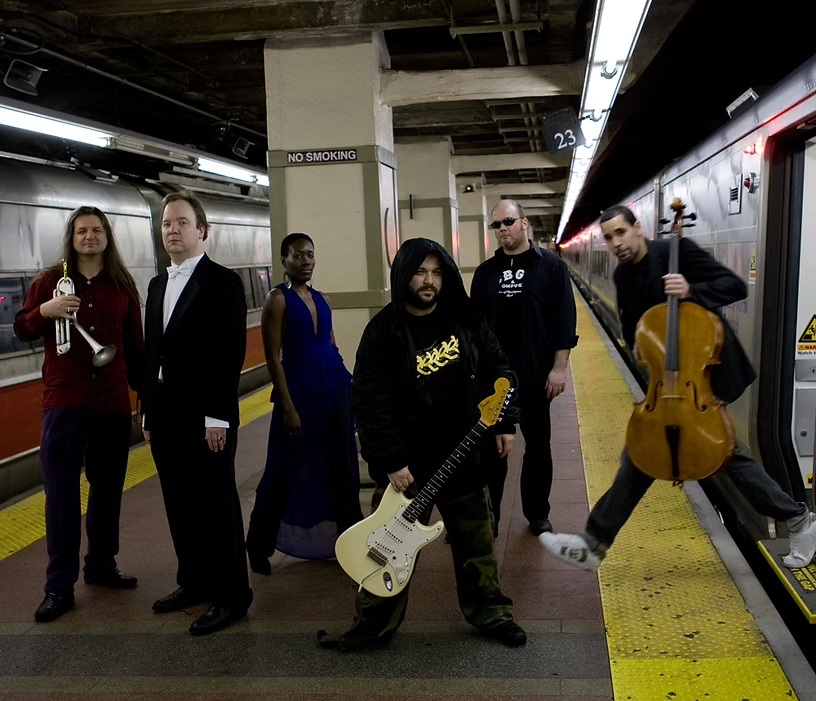


![Resilience in Sound: Block's 'Whitecaps On The Hudson [Deluxe Edition]'.](https://i0.wp.com/www.musicarenagh.com/wp-content/uploads/2025/06/BLOCK1.jpg?resize=696%2C465&ssl=1 "Resilience in Sound: Block's 'Whitecaps On The Hudson [Deluxe Edition]'.")
![Resilience in Sound: Block's 'Whitecaps On The Hudson [Deluxe Edition]'.](https://i0.wp.com/www.musicarenagh.com/wp-content/uploads/2025/06/BLOCK.jpg?resize=696%2C465&ssl=1)